Controlled Rolling Parameters | Main Variation Trend | Impact on Microstructure | Impact on Macroscopic Properties (Typical Changes) |
Increasing Deformation Amount | e.g., increasing from 40% to 80% | Grains are elongated/refined along rolling direction; dislocation density rises; ferrite (α) phase proportion may increase. | Strength & hardness improve significantly. Plasticity may first rise then drop; fracture mode may shift to brittleness under large deformation. |
Lowering Rolling Temperature | e.g., decreasing from 1000℃ to 600℃ | Inhibits grain growth (finer microstructure); helps form micro-nano composite structure. | Strength is further enhanced, but plasticity may decrease. Low-temperature finish rolling (e.g., 850℃) boosts composite plate interface bonding strength. |
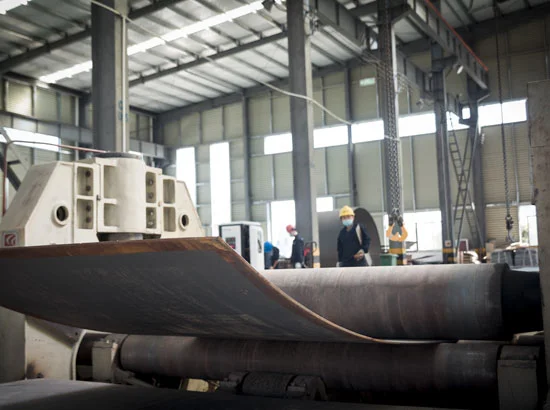
Adopting Special Rolling Processes | e.g., variable-thickness/asymmetric rolling | Improves internal deformation uniformity; reduces edge damage/unfavorable texture. | Enhances formability & product quality (e.g., less edge cracking); asymmetric rolling improves tensile properties. |
Controlling Cooling After Finish Rolling | Rapid cooling (>10℃/s) between 1050-500℃ | Inhibits brittle phase precipitation; obtains uniform two-phase equilibrium microstructure. | Achieves excellent comprehensive mechanical properties and corrosion resistance. |
The root cause of controlled rolling's significant influence on material properties is that it alters the material's "gene"—its microstructure:
Phase Proportion & Morphology Regulation
2205 duplex stainless steel consists of austenite (γ) and ferrite (α) phases. Controlled rolling precisely adjusts the proportion and morphology of these two phases. For example, higher rolling temperature or larger deformation usually increases ferrite content. Meanwhile, high-temperature deformation elongates grains along the rolling direction, while low-temperature rolling refines grains more effectively (even forming microcrystal-nanocrystal composite structures)—the key to achieving high strength and plasticity.
Defect & Texture Introduction
Rolling deformation generates high-density dislocations inside the material. These entangled dislocations hinder subsequent deformation, thus enhancing strength and hardness (work hardening effect). In addition, different rolling methods (e.g., symmetric/asymmetric rolling) affect grain orientation (texture), which in turn changes the material's anisotropy and formability.
Weigh process parameters according to your primary goal:
Pursuing high strength: Use lower rolling temperature (e.g., 600-800℃) with larger deformation (e.g., 50%-70%)—this maximizes grain refinement strengthening and dislocation strengthening.
Pursuing high plasticity/formability: Adopt higher rolling temperature (e.g., ~1000℃) with moderate deformation to get better phase balance and grain morphology; or use advanced processes like asymmetric rolling to improve formability.
For composite plate preparation: Lower finish rolling temperature (e.g., 850℃) boosts interface shear strength; rapid cooling (>10℃/s) after rolling is critical for excellent microstructural properties.
Controlling production cost & quality: To balance cost-efficiency with product quality, Gallianz employs innovative processes such as variable-thickness cross rolling. This technique minimizes edge cracking in strips, thereby improving material yield and ensuring consistent product quality—key advantages that distinguish Gallianz from conventional plate suppliers.

 English
 日本語
日本語 한국어
한국어 français
 Deutsch
 Español
 italiano
 русский
 português
 العربية
 فارسی
فارسی