In pressure vessel manufacturing, selecting the appropriate vessel head is critical to ensuring safety, durability, fabrication efficiency, and long-term operational performance. Among the most commonly used dished heads are the elliptical head and the torispherical head. Although both are widely applied in pressure vessels such as storage tanks, boilers, heat exchangers, and other process equipment, they differ significantly in geometry, stress distribution, pressure resistance, and manufacturing cost.
This article focuses on the two most common dished head types used in pressure vessels operating under static or moderately cyclic loading conditions, aiming to help engineers and buyers select the appropriate head type based on pressure requirements, cost considerations, and fabrication constraints.
An elliptical head is a pressure vessel head formed with an elliptical profile. The most common type is the 2:1 elliptical head, where the major axis is twice the minor axis.
The shape provides excellent stress distribution under internal pressure, making it one of the most efficient and widely used head designs in pressure vessel fabrication.
Smooth elliptical geometry
Lower stress concentration
Higher pressure resistance
Reduced wall thickness requirements
Good balance between strength and fabrication cost
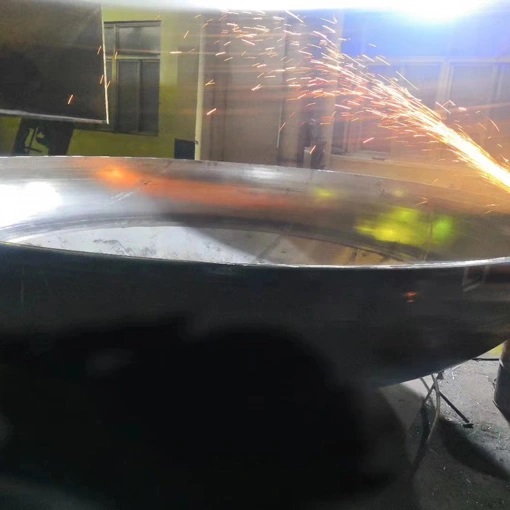
A torispherical head is a vessel head consisting of:
A spherical crown section
A toroidal knuckle radius
According to ASME VIII-1, the knuckle radius must be at least 6% of the head inside diameter, and the spherical crown radius must be ≤ the inside diameter.
It is sometimes called a flanged and dished head (F&D head).
Torispherical heads are commonly used because they are easier and cheaper to manufacture than elliptical heads. However, they generally experience higher stress concentrations near the knuckle region. Under the same internal diameter and pressure conditions, torispherical heads generally require thicker plate than elliptical heads.
Shallower profile
Lower forming cost
Compact vessel height
Easier fabrication
Higher stress concentration than elliptical heads
Although both head types are designed for pressure-containing equipment, their structural behavior and performance differ substantially.
| Feature | Elliptical Head | Torispherical Head |
|---|---|---|
| Shape | Elliptical profile | Spherical crown + toroidal knuckle |
| Pressure Resistance | Excellent (For same diameter& pressure, elliptical head requires 15-30% less thickness) | Moderate |
| Stress Distribution | More uniform | Higher knuckle stress |
| Material Efficiency | Higher material utilization | Lower material utilization |
| Manufacturing Cost | Higher | Lower |
| Head Depth | Deeper | Shallower |
| Required Thickness (Under identical design conditions) | Usually thinner | Usually thicker |
| Fatigue Resistance (Especially important for cyclic pressure service) | Better | Lower |
| ASME Performance | Favored by ASME VIl for high pressure | Acceptable but with stress penalties |
| Typical Applications | High-pressure vessels | Low/medium-pressure tanks |
Fabricability | More difficult to form | Easier to manufacture, especially large diameters |
Choosing the correct elliptical head depends on multiple engineering and operational factors.
Operating pressure is one of the most critical factors in head selection.
For high-pressure applications (typically > 200 psi / 1.4 MPa) or systems involving cyclic loading, 2:1 elliptical heads are strongly recommended due to their superior stress distribution and fatigue resistance. The smooth curvature reduces stress concentration, making them ideal for critical pressure vessels.
In contrast, for low-pressure applications (< 100 psi / 0.7 MPa) and non-cyclic storage tanks, torispherical heads are often sufficient. Their simpler geometry makes them more economical while still meeting safety requirements in less demanding environments.
Vessel diameter significantly influences manufacturing complexity and forming feasibility.
For large-diameter pressure vessels, elliptical heads are generally preferred when long-term structural integrity and uniform stress distribution are required. However, they may require advanced forming techniques and stricter dimensional control.
Torispherical heads are easier to manufacture for a wide range of diameters and are often used when cost efficiency and faster fabrication are priorities. For very large tanks with moderate pressure, they can provide a practical and economical solution.
Both elliptical and torispherical heads can be manufactured from similar materials, but the selection should align with operating conditions.
For high-pressure, corrosive, or high-temperature environments, elliptical heads are often preferred because their geometry better supports demanding service conditions.
For less aggressive environments and standard storage applications, torispherical heads provide a cost-effective material utilization option without compromising basic performance.
Both head types must comply with applicable design codes and regulatory standards.
Elliptical heads are often selected in systems requiring stricter compliance due to their superior stress performance under code calculations.
Torispherical heads are widely accepted under the same standards but are more commonly used in general-purpose or lower-pressure equipment where design margins are less demanding.
Cost is often the deciding factor in head selection.
If budget is limited and the system operates under moderate pressure conditions, torispherical heads are typically the most cost-effective choice due to simpler forming processes and lower material usage.
However, when evaluating life-cycle cost, elliptical heads often provide better long-term value. Their enhanced fatigue resistance and pressure-handling capability reduce maintenance needs and improve operational reliability in demanding service conditions.
Elliptical heads distribute stress more evenly, reducing stress concentration and improving pressure resistance.
Industries include:
Oil & gas
Chemical processing
Pharmaceutical
Food processing
Power generation
Water treatment
Reliable elliptical head suppliers should have ASME manufacturing capability and advanced forming equipment. They should also provide full material traceability, hold recognized quality certifications, and have proven experience in completed projects.
Common materials include carbon steel, stainless steel, duplex steel, alloy steel, titanium, and nickel alloys.
For a given diameter and thickness, the allowable pressure of an elliptical head can be 30–50% higher than that of a torispherical head with equivalent dimensions, depending on knuckle geometry.
Elliptical heads and torispherical heads are both widely used in pressure vessel design, but they serve different engineering needs.
Elliptical heads (2:1) are recommended for high-pressure, cyclic loading, or safety-critical applications because they provide better stress distribution, higher pressure resistance, and improved fatigue performance.
Torispherical heads are more suitable for low-pressure, non-cyclic service, or cost-sensitive projects due to their simpler geometry and lower manufacturing cost.
In general, elliptical heads are preferred when performance and reliability are the main priorities, while torispherical heads are chosen when fabrication economy and simplicity are more important.
 English
 日本語
日本語 한국어
한국어 français
 Deutsch
 Español
 italiano
 русский
 português
 العربية
 فارسی
فارسی